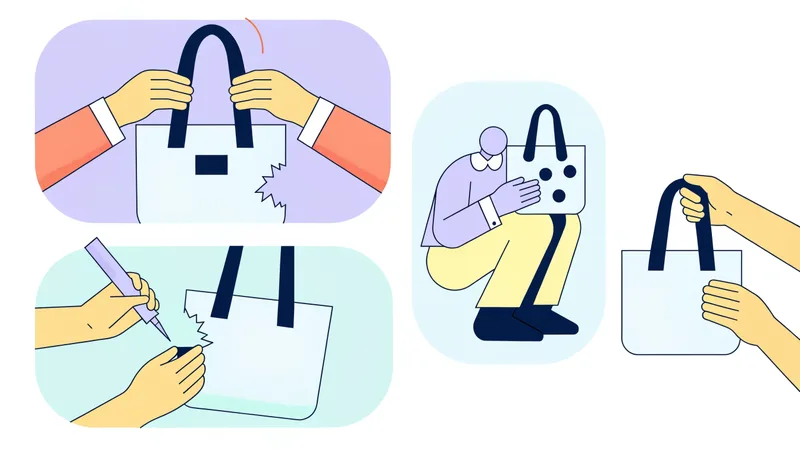
Do recycled-material bags last?

Good recycled polyester durability is possible, but recycled content alone cannot predict a finished bag's lifespan. A 2022 woven-fabric comparison found no statistically significant differences in the physical properties measured. For a buying decision, look beyond the fiber label to construction, care and repair support.
What recycled polyester durability research actually shows
Recycled polyester means polyester made using recovered material. Textile Exchange's recycled-material standards provide a framework for verifying that content and following it through the supply chain. The recycled designation answers a sourcing question. Treat durability as a separate question.
In the 2022 comparison, virgin fabric had numerically higher tensile strength, elongation and abrasion strength. However, those differences were not statistically significant. That supports the possibility of comparable performance for the fabrics studied. It does not establish identical performance for every recycled fabric.
The 2023 research examined knitted sportswear fabrics, comparing recycled polyester with standard polyester containing elastane. Its abrasion results favored the standard samples. These were different fabric groups, with different compositions, intended for clothing.
Together, the findings resist a simple stronger-or-weaker verdict. They are not matching experiments on finished backpacks. Neither paper supplies a universal service life for luggage or totes.
The practical inference is modest: do not reject a bag solely because its polyester is recycled. Equally, do not accept a durability promise solely because it is recycled.
Separate the label from the evidence
Use this table as a reading checklist, rather than a ranking of materials. The strongest answer is one that addresses your actual concern.
| Information you find | Question it helps answer | Useful follow-up |
|---|---|---|
| Recycled-content percentage | How much claimed material is recycled? | Which component does that percentage describe? |
| Certification name | What sourcing or processing criteria apply? | Can you identify the scheme and its scope? |
| Fabric test report | How did that sample perform under the stated method? | Is it the same fabric used in this bag? |
| Finished-bag test description | What assembly or loading was assessed? | Are the method and conditions explained? |
| Repair policy | What happens after damage? | Are parts, labor and exclusions specified? |
For example, imagine a listing that identifies recycled lining but says little about the shell. Record the lining claim as a lining claim. Do not silently extend it to the whole bag.
The FTC says marketers should qualify claims for partly recycled products. Applied to shopping, that means reading the noun beside the percentage: fabric, lining, shell or product.
For the sourcing terminology behind these labels, see recycled bag fabrics.
Assess the finished bag, component by component

Start with the job you need the bag to do. Write down what you carry, where the bag rests and which openings you use repeatedly. Then inspect those areas.
For a work bag, examine the handle attachments and the access to your computer compartment. For a grocery tote, examine its base and carrying handles. For wheeled luggage, include the wheels and handle assembly.
These are inspection priorities, not a claim that one visible detail guarantees a particular lifespan. A neat photograph is not a substitute for a relevant test.
Ask for clear close-ups of the interior seams, strap anchors and base. Read any stated load limit without inventing one where none is supplied. Notice whether the lining prevents access to hardware you might eventually need replaced.
If a seller publishes test results, look for the sample identity and test conditions. Treat a result for one fabric as evidence about that fabric. Do not turn it into a promise about a zipper, seam or wheel.
Use how to judge bag quality to organize the inspection. The aim is to compare complete bags that suit the same task, rather than isolated environmental labels.
Read warranties as support commitments
A warranty can tell you how a company proposes to handle failure. It cannot tell you the date your bag will fail.
For a specific example, Osprey's US All Mighty Guarantee covers functional repairs, with exclusions and special limits for certain products. Cosmetic wear that does not affect function is excluded. These terms were checked in November 2026.
That distinction matters when evaluating a scuffed but usable bag against one with a failed closure. Read the policy for the exact model and market, rather than borrowing terms from another collection or country.
Before buying, make a short support record: where a claim starts, what proof is requested and what happens if repair is impossible. Ask about shipping responsibilities, parts availability and turnaround before relying on them.
Also consider the outcome you would accept. Would you keep a visible patch? Would a differently colored replacement buckle bother you? Would replacement instead of repair defeat your reason for choosing the bag?
See bag warranties explained for a fuller reading checklist. Warranty interpretation here is general information, not legal advice.
What it means when you shop
Compare like with like. First shortlist bags that meet your size, access and carrying needs. Then compare their material disclosures and support arrangements.
Consider a hypothetical pair of commuter bags. One discloses its recycled shell percentage and a repair route. The other offers only a broad environmental slogan. Prefer the clearer evidence when it answers your priorities, without assuming the first bag must outlast the second.
Keep a copy of the specifications and care instructions for whichever bag you choose. Follow the instructions for that finished product; do not transfer cleaning advice from an unrelated fabric sample.
The wider question belongs in sustainable bags: what is the claim, what supports it and how does it affect your decision?
Two shortcuts deserve retiring. Recycled does not automatically mean fragile, as the 2022 comparison illustrates. Recycled also does not automatically mean longer-lasting: the studies examined specific fabrics under specific conditions.
Use recycled polyester durability as one question in your assessment, alongside suitability and repairability. The recycling label should start a useful investigation, rather than finish it.

FAQ
Are recycled polyester bags weaker?
Not necessarily. The 2022 woven-fabric study found no statistically significant physical differences between its compared fabrics. That is evidence about those samples, not every bag. Assess the specific construction and any relevant published tests instead of treating recycled content as a strength grade.
How many years will a recycled backpack last?
There is no universal lifespan established by the studies discussed here. They examined fabrics, not years of ownership across finished backpacks. For a particular bag, look for relevant testing, care instructions and repair support. Treat an unsupported years-of-use promise cautiously, regardless of the material's recycled percentage.
Does GRS certification mean a bag is abrasion tested?
Do not use it as evidence of an abrasion result. Textile Exchange describes GRS in terms of recycled content, chain of custody and additional processing requirements. If abrasion performance matters for your use, look for a separate report identifying the fabric, method and result.
Should I replace a working bag with a recycled one?
Do not make the label alone your reason to replace it. First decide whether your current bag still does its job and whether repair would address any problem. If you need a replacement, compare suitable bags using specific material claims, construction information and support terms rather than a broad green slogan.