How to tell if a bag is good quality: zippers, buckles and stitching
Knowing how to tell if a bag is good quality comes down to three checks: closures move cleanly, load-point stitching holds, and straps anchor to reinforced fabric. Look closely at those details before trusting a glossy product photo. Zipper brands and heavy-looking hardware help only when the complete construction is sound.
Start with the parts that carry the load
A bag's most important seams are not necessarily the longest ones. Examine where shoulder straps meet the body, where a handle connects, and where a shoulder strap clip attaches. Those locations carry concentrated force when a packed bag is lifted or swung onto a shoulder.
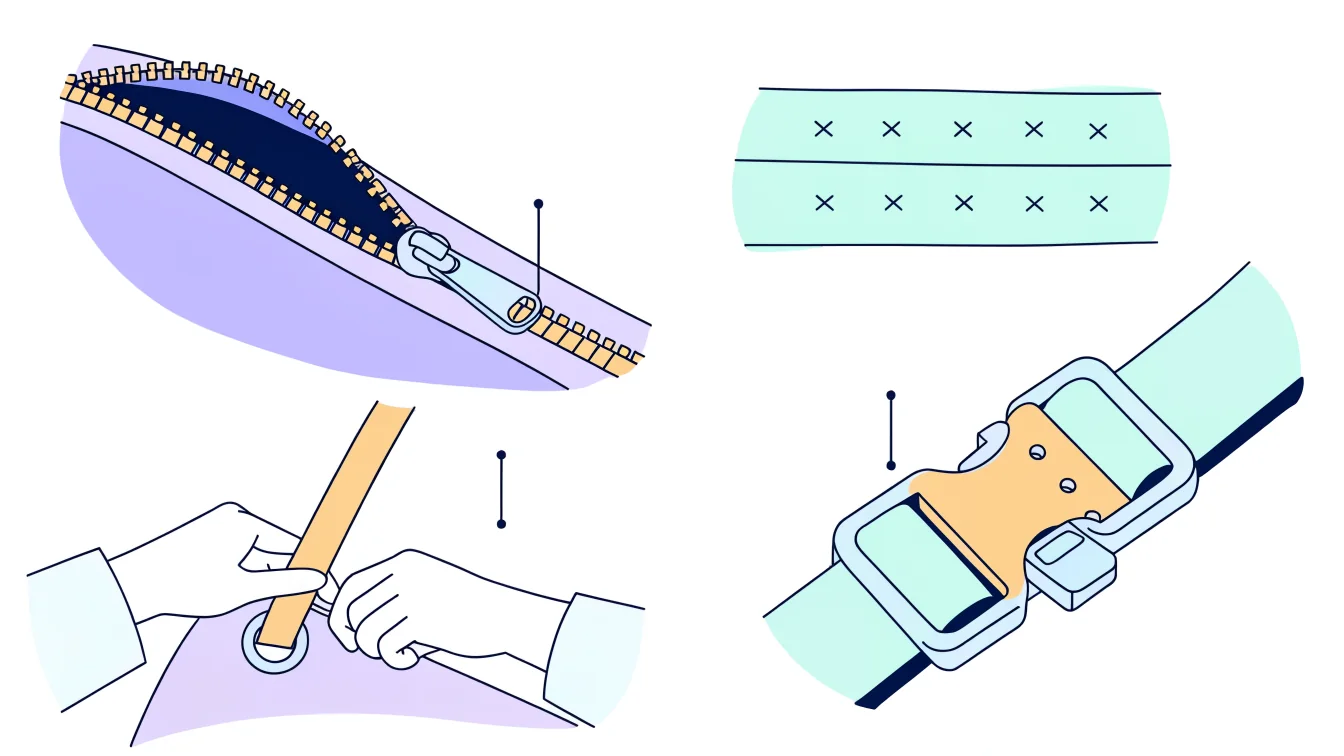
Look for stitching that runs evenly along the attachment, without obvious skipped areas or loose loops. A box-shaped stitch pattern with diagonal stitching can spread forces across an attachment. A bartack, which looks like a dense short bar of stitches, can reinforce an edge or strap end.
Neither detail proves a bag's tested strength. What matters is whether the fabric beneath it can support that load.
Check that handle anchors are attached to structural panels, not only to a thin lining. Tug gently on a store sample if the store allows it; the attachment should not gape or pull loose. Leave destructive tests to the lab.
Online, zoom in on strap roots and bottom corners. Product photos often show the front of the bag beautifully while hiding the areas most likely to receive repeated stress.
How to evaluate a zipper
| Detail | Promising sign | Warning sign | What it cannot prove |
|---|---|---|---|
| Slider movement | Smooth movement on an unloaded bag | Snagging despite clear fabric | Long-term life |
| Teeth or coil | Consistent alignment | Visible gaps or bent elements | Waterproofing |
| Ends | Securely terminated zipper | Loose stitching beside stops | Resistance to overload |
| Flap or cover | Adequate clearance | Cover routinely catches | Weather protection rating |
| Zipper size | Appropriate to opening and load | Tiny closure on heavily stressed compartment | Actual pull strength |
YKK explains that zipper strength is evaluated with different tests. Its fastening catalog classifies zippers by chain width (the width of the engaged elements) and warns that "even items meeting the same JIS class have different strengths per item." The stamp on a slider therefore identifies the zipper; it does not certify the bag.
Inspect the zipper track where it turns around corners. Tight turns can increase friction, particularly on a stuffed bag. If a zipper requires forcing when the bag is empty, imagine how cooperative it will be with a weekend's clothes inside.
Check whether the zipper opens far enough for the way you pack. A robust zipper that leaves a narrow opening can make a large bag frustrating to use.
Buckles, clips and metal hardware
A side-release buckle should click into place without unusual pressure. Both release tabs should work.
Its halves should meet squarely rather than twist. If the bag uses metal swivel hooks, inspect whether the hook closes fully and turns without scraping.
Hardware thickness alone does not tell you its load rating. Plastic hardware can work well in appropriate designs; metal hardware can add weight and sometimes catch on clothing. Look instead at how the clip joins the strap and whether the webbing can slip through its adjuster.
On a loaded messenger bag, webbing that gradually creeps through an adjuster can be more annoying than a mildly stiff buckle. On a hiking pack, a buckle that is difficult to operate with cold hands may be a practical limitation.
For a buckle marketed with a load rating, seek a published rating and intended-use guidance. Do not assume any everyday bag buckle is suitable for climbing or personal safety equipment.
Stitching: what is worth checking?

More stitches are not automatically better than fewer, well-placed ones. Stitching makes holes in fabric; extreme density can weaken some materials if not engineered properly. No universal stitches-per-inch target guarantees quality across leather, nylon, coated fabric and canvas.
Look for even spacing, stable thread tension, and stitching that does not wander off the fabric edge. At stress points, reinforcement is more useful than decorative double rows on a low-stress panel.
Check the inside of the bag if the lining permits it. Exposed seam allowances should be finished rather than shedding threads at first touch.
Fabric fraying, cut edges and unfinished holes are meaningful signs. So are strap anchors sewn through only a narrow strip of fabric. Cosmetic flaws do not always mean structural failure, but mismatched seams deserve examination.
How to tell if a bag is good quality in store or online
In a store
- Run the zipper on the empty bag; it should not snag.
- Click both buckle release tabs.
- Tug a strap root gently, if the store allows it.
- Look inside at the seam allowances for loose threads.
Online
- Zoom in on strap roots, bottom corners, zipper ends and interior seams.
- Read the warranty terms.
Use product photos as evidence, not proof. If the listing shows only distant lifestyle images, ask the seller for construction details before buying an expensive bag.
A credible warranty is another useful clue. Read what the seller actually covers, how claims are handled and whether shipping costs apply.
A long warranty cannot compensate for a bag that fits poorly or has an awkward closure. For more detail, see bag warranties explained.
You can also compare fabric specifications in denier explained. Denier alone is not proof of strength, just as a branded zipper alone is not proof of durability.
Myths that make bag shopping harder
A bigger zipper is always better. An oversized zipper can be bulky and stiff. The right design balances ease of use, strength and the bag's intended load.
Metal buckles always outlast plastic. Materials alone cannot determine a particular buckle's life. Geometry, load and attachment design matter too.
More stitching means a stronger bag. Stitch placement and seam design are more meaningful than simply counting rows.
A bag labeled heavy-duty must withstand any load. Without a stated test method and load rating, heavy-duty is descriptive marketing language.
The bag construction hub covers the rest of the build, and the bag buying guides match features to each bag type.

FAQ
How can you tell if a bag has good stitching?
Look for even stitch lines, no missing sections and reinforcement at handles and strap roots. Examine the underside or lining where accessible. Well-placed reinforcement is more useful than a decorative second row on an unstressed surface.
Are YKK zippers always better?
YKK publishes testing methods and makes different zipper products. That is not a guarantee for every bag using one. The zipper's model, placement and installation still matter. YKK's fastening catalog lists the strength tests involved, such as chain crosswise strength and top stop holding strength.
What should I check on a backpack first?
Start at the shoulder strap attachments, main zipper, top handle and bottom corners. Those areas see frequent handling or concentrated loads. Then examine comfort, pocket layout and the bag's fit for your actual gear.
Does thick fabric mean a bag is durable?
Not necessarily. Fabric thickness alone omits fiber type, weave, coating, seam quality and abrasion behavior. Ask for measurable specifications rather than treating a thick feel as a durability certificate.
Can photos prove a bag is high quality?
Photos can expose poor seam finishing and weak-looking anchors, but they cannot verify load ratings or long-term wear. Look for detailed product information and clear warranty coverage alongside the images.