How many times do you need to reuse a tote bag?

Deciding how many times to reuse a tote bag requires a comparison: there is no universal environmental break-even count. A break-even estimate describes when one modeled bag matches another on a specified impact. Keep using a suitable existing tote rather than treating any threshold as its retirement date.
How many times to reuse a tote bag: read the comparison
Start with the reference carrier and the environmental measure. These examples are study results, not predictions for an unidentified tote.
| Named study | Tote or carrier | Climate comparison | Reported threshold |
|---|---|---|---|
| Environment Agency, 2011 | Cotton | HDPE reference with no secondary reuse | 131 total shopping uses |
| Environment Agency, 2011 | Cotton | HDPE reference with 40.3% reused as bin liners | 173 total shopping uses |
| Danish EPA, 2018 | Conventional cotton | Average LDPE reference subsequently used as a waste-bin bag | 52 primary reuses |
| Danish EPA, 2018 | Organic cotton | Same Danish LDPE reference | 149 primary reuses |
Sources: UK report, summary table; Danish report, Table IV.
Notice that the reports describe uses and reuses differently. Preserve their labels when quoting them instead of silently adding or subtracting a trip.
The practical question is which scenario resembles your actual replacement. An estimate against unreused thin film is not interchangeable with one crediting a waste-bin liner.
For the wider material decision, read our paper, plastic, and cotton comparison.
Why the estimates differ so much
Life-cycle assessment needs a defined question. ISO 14040 includes goal and scope, inventory, impact assessment, and interpretation within its framework. ISO
For shopping bags, look for the load being carried and what replaces what. Equal bag counts do not necessarily describe equal service.
UNEP's 2020 review identifies differences in bag weights, capacity assumptions, production systems, and waste treatment across studies. Those choices can change the comparison. UNEP
The Danish report's conventional-cotton threshold reaches 7,100 reuses when covering all its indicators. Its largest cotton values are driven by modeled ozone depletion, not climate change. Danish EPA, 2018
That distinction matters whenever a headline offers one enormous number. Ask what environmental indicator produced it before interpreting it as a shopping instruction.
Do not average a climate figure and an all-indicator figure. They answer different questions. Nor should you apply either result to every tote bearing the same fiber name.
Our sustainable bags guide puts these comparisons alongside the other questions involved in choosing and keeping a carrier.
Count useful service, rather than calendar time

Make your own tally about behavior, not a claim of verified emissions savings. Record when the tote actually carried a useful load.
A month in a closet is not a shopping use. Nor should you count walking into a store with an empty tote as replacing a checkout carrier.
Keep the method simple. Note the date, job, and whether you would otherwise have accepted another bag. Use the same approach each time.
For illustration, imagine a tote used for two shopping trips each week. One hundred recorded trips would take 50 weeks. This is arithmetic, not a new environmental threshold.
| Hypothetical routine | Calculation | Time for 100 recorded trips |
|---|---|---|
| Once each week | 100 ÷ 1 | 100 weeks |
| Twice each week | 100 ÷ 2 | 50 weeks |
| Four times each week | 100 ÷ 4 | 25 weeks |
The example does not assume all trips replace identical shopping loads. It simply shows why your routine matters more than the tote's age.
If you rotate several bags, track each separately. One busy household shopping schedule does not establish equal use for every carrier in the cupboard.
What it means when you shop
Before choosing another tote, list the carriers you already own. Identify which fit the shopping you actually do and which need attention.
Assign each useful bag a job. Keep the regular grocery carrier near your shopping list, and put a spare wherever you prepare for unplanned errands.
For a new bag, ask for fiber composition, dimensions, care instructions, and any published load guidance. Choose around that information rather than a promised environmental milestone.
If a seller supplies an LCA claim, ask for the named study and matching product. Look for the reference carrier, impact category, geographic setting, and use assumptions.
Treat a recycled-content claim separately from a complete footprint claim. The FTC advises checking the claimed amount and whether it concerns the product or packaging. FTC
Follow the maker's cleaning instructions. Our tote washing guide helps organize the care questions without assigning every fabric the same method.
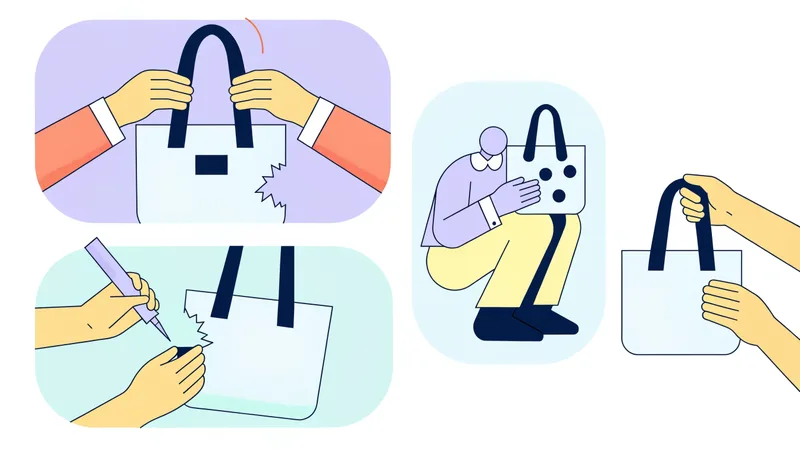
When a handle or seam needs attention, assess the actual damage. Use our repair-or-replace guide to decide your next step.
Myths that confuse the reuse question
Every tote has one official target. The studies above do not establish that. Their figures belong to defined designs, reference bags, and impact measures.
An environmental seal answers every question. The FTC says seals should make clear which environmental benefits were evaluated. Read that scope before interpreting a logo as a complete assessment. FTC
The target tells you when to replace the bag. A comparison threshold is not a care instruction or a demonstrated failure point. Inspect the bag's actual condition.
An enormous number must describe climate impact. Denmark's all-indicator cotton result illustrates why that inference can be wrong. Keep the impact measure attached to the figure.
A new tote fixes an unused tote collection. Before adding another carrier, decide what useful task it would perform. Try reorganizing existing bags first.
When discussing how many times to reuse a tote bag, keep the question specific: which carrier, replacing what, and measured how? That wording makes the answer more useful.
FAQ
Do I need to use every cotton tote 131 times?
No universal requirement follows from that figure. It belongs to a particular UK comparison, shown above. Use it to understand the role of repeated service, rather than to certify your own bag. Keep the tote's actual design, condition, and replacement role in view when planning future use.
Does using a tote for work count?
It counts as useful service in your personal record, but it may not match a grocery-bag study's functional comparison. Record the job honestly. If it carried work items rather than replacing a shopping carrier, do not automatically report that trip as an avoided disposable grocery bag.
Should I stop using a tote after the break-even point?
No. A modeled threshold does not tell you the bag has reached the end of its useful life. Continue assessing condition and suitability. If damage prevents the planned job, consider an appropriate repair or another existing carrier. Avoid replacing a working bag simply because your tally reached a particular number.
Can I calculate my exact savings from the material label?
A material label alone does not supply a product-specific life-cycle inventory or comparison. ISO's framework includes scope, inventory, impacts, and interpretation. Without relevant evidence, keep your tally as a record of use. Do not convert it into a precise emissions-saving claim or a universal environmental score. ISO
Sources
- assets.publishing.service.gov.uk/media/5a7bff74ed915d01ba1ca7c7/scho0711buan-e-e.pdf
- orbit.dtu.dk/files/151577434/2018_Life_Cycle_Assessment_of_grocery_carrier_bags_Environ…
- wedocs.unep.org/server/api/core/bitstreams/980e2d43-c3e2-4f2e-8e79-1d8cfc748981/content
- iso.org/standard/37456.html
- consumer.ftc.gov/articles/eco-friendly-and-green-marketing-claims