How bags are made: from pattern to factory
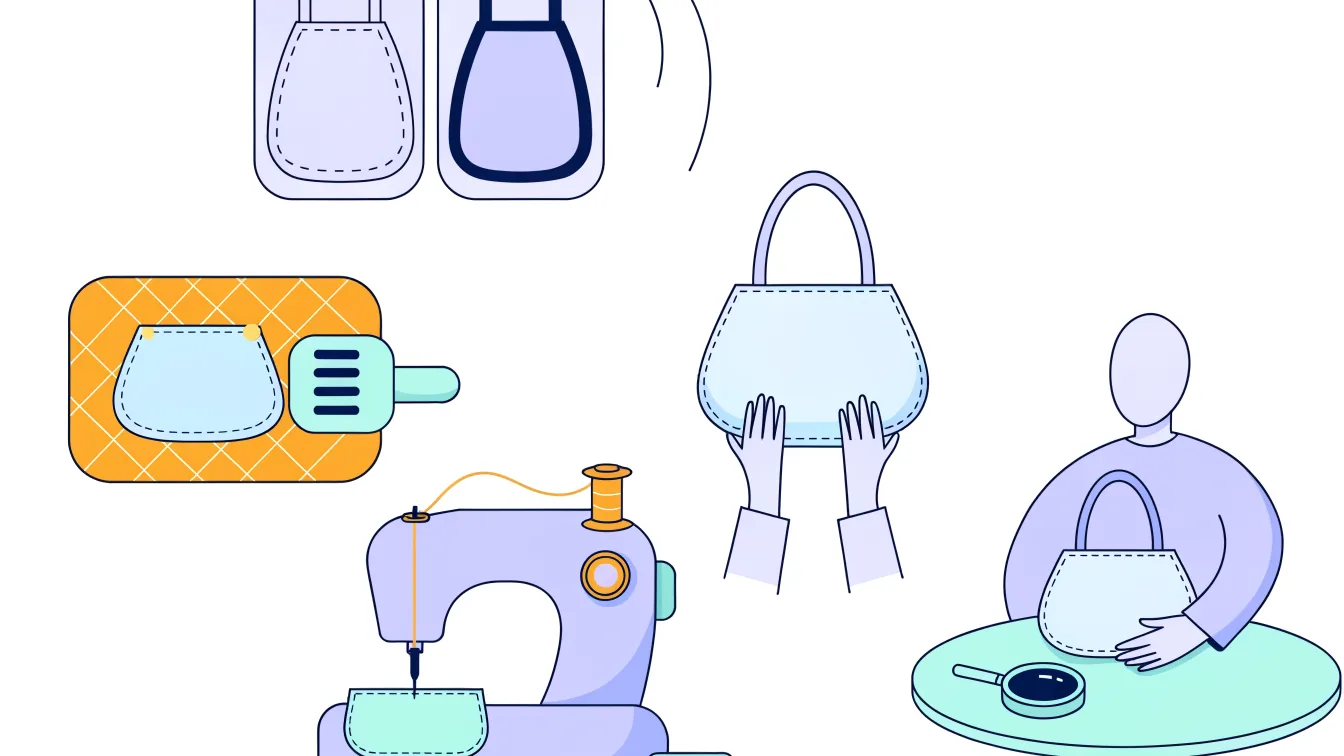
If you ask “how are bags made,” the short answer is that materials are patterned, cut or formed, assembled, and inspected. Factory process Fabric bags and rigid suitcases follow different production routes, so compare the construction details rather than expecting one universal factory method.
The answer to “how are bags made” starts with a pattern
A pattern translates the design into pieces for production. A maker's factory account describes digitized two-dimensional patterns printed for fabric cutting.
The maker's production overview lists fabrics, webbing, foam, binding, zippers, and hardware in its bill of materials. The pattern and component list serve different jobs.
So, how are bags made from those prepared components? Use this simplified production map to follow the sequence. It describes the cited cut-and-sew example, rather than every factory.
| Stage | Input | Result |
|---|---|---|
| Planning | Design and component list | Materials prepared for production |
| Cutting | Fabric and printed patterns | Separate shaped panels |
| Subassembly | Panels, lining, and hardware | Partly assembled sections |
| Joining | Prepared sections | Three-dimensional bag |
| Reinforcement and inspection | Assembled bag | Finished item checked against production requirements |
The stages follow the factory sequence and the manufacturer's production account.
For a concrete design detail, another maker account describes curved seams that draw a flap bag's sides inward. That shows why a panel's outline deserves attention alongside its fabric.
Use the bag construction guide to identify those details on a finished product.
Cutting, sampling, and revisions before a full batch
Production development includes more than preparing the final pattern. A 2018 handbag manufacturer's prospectus describes making a production sample before mass production.
In that account, paper patterns, purchased materials, and planned procedures all contribute to the sample. The customer generally approves it before larger-scale manufacturing begins.
A separate 2023 design account describes multiple samples and pattern corrections. Changes included component selection, lining dimensions, foam, and handle placement.
The maker also describes a small pre-production batch used to trial the manufacturing steps. That is a specific production practice, not a certification for every bag.
When reading a development story, distinguish the first concept from the version actually sold. Look for which details changed and which remain in the final specification.
For your own comparison, identify the practical outcome of a revision. Consider the opening, pocket arrangement, handle position, or replaceable component involved.
Avoid judging development by the number of sketches or samples alone. Prefer an explanation connecting a construction choice to the finished design you are evaluating.
Sewing turns panels into usable storage

A fabric bag can be built in sections before the final joins. The factory sequence describes attaching lining, zipper parts, and other details to individual panels.
A different construction example explains a drop-in lining made by joining an outer shell with a separately sewn interior. The assembly is then turned right side out and finished.
Those examples explain why an interior seam may look different from an exterior seam. Inspect each area according to its purpose rather than expecting identical finishing everywhere.
Assembly also includes more than stitching alone. The handbag manufacturer's prospectus describes sewing, gluing, and assembling different components.
For a finished bag, examine how the opening, lining, and attachment points meet. Rehearse using the zippers and pockets with your intended contents.
Also consider repair access. One maker describes changing a buckle arrangement so a replacement can be fitted by unpicking a few stitches.
The backpack anatomy guide and handbag anatomy guide help name the components during that inspection.
Rigid shells take a different production route
Rigid luggage does not begin with the same panel-sewing sequence as a fabric backpack. A manufacturer's 2018 report identifies two plastic-shell production routes.
It describes using polycarbonate and polypropylene sheets for vacuum and pressure forming. It also describes polypropylene granules for injection molding.
A machinery supplier provides a specific thermoforming example involving sheet feeding, preheating, fixing, forming, and discharge. These are details of the supplied manufacturing equipment.
Do not assume every rigid suitcase uses that exact material or process. Establish the material and construction stated for the particular model.
Then inspect the assembled suitcase as a whole. Compare its frame or zipper opening, lining, handles, and wheel attachments with the features you need.
Treat the shell description as one part of that comparison. A material name alone does not explain every connection or demonstrate the performance of the finished case.
For component names, see suitcase anatomy. Use those names when reading a maker's diagrams or asking about a particular assembly detail.
Quality control and what it means when you shop
Visual inspection looks for manufacturing defects. The 2018 prospectus describes checks of seams, sewing accuracy, loose thread, labels, and finished goods.
Performance testing examines different questions. A luggage maker describes loaded drop tests, repeated zipper operation, wheel trials, handle tests, and tumble tests.
These are published maker practices. They should not become an assumed test result for an unrelated bag or an unsupported guarantee of lifespan.
When shopping, connect a test claim to the product it covers. Look for the tested load, procedure, and outcome when the maker supplies those details.
Avoid three shortcuts: assuming handwork automatically proves quality, assuming molded construction means no assembly, or assuming factory inspection establishes lifetime performance.
Instead, compare the visible construction with the published specification. Operate the closures, inspect the attachment points, and identify the available repair route.
Use the bag quality guide for a closer inspection. A manufacturing story is most useful when it helps explain an actual feature or connection on the finished bag.

FAQ
Are fabric bags made from one piece of material?
Not necessarily. The published cut-and-sew sequence uses separate pattern pieces and subassemblies. Those are joined into the finished shape. Inspect the bag's construction rather than inferring its panel count from the outside. Examine the lining, reinforcement, and assembly details separately when evaluating the design.
Why do bag factories make samples first?
A manufacturer's prospectus describes production samples approved before mass production. A separate development account describes correcting patterns and components through sampling. These examples show how a proposed design becomes a repeatable production process. The specific sampling method still depends on the maker and product involved.
Are all plastic suitcases injection molded?
No. A manufacturer's 2018 report describes sheet-based vacuum and pressure forming as well as injection molding. Identify the stated process for the model rather than inferring it from the shell's appearance. Consider the finished assembly and published tests alongside the material or manufacturing label.
Does quality inspection mean a suitcase cannot break?
Do not interpret inspection as an unlimited performance guarantee. Makers describe visual factory checks and mechanical test procedures, which address particular requirements. Look for the conditions behind a performance claim. Inspect the actual bag and identify its repair options as separate parts of your decision.
Sources
- tombihn.com/blogs/main/how-tom-bihn-bags-are-made
- tombihn.com/blogs/main/making-of-a-cafe-bag
- tombihn.com/blogs/main/production-and-design-notes-trinity
- www1.hkexnews.hk/listedco/listconews/sehk/2018/0110/ltn20180110011.pdf
- corporate.samsonite.com/on/demandware.static/-/Sites-InvestorRelations-Library/default/…
- valtechgroup.eu/en/projects/innovative-technology-for-samsonite-suitcases
- shop.samsonite.com/innovate-to-move-the-world.html