Pockets, purses and why women carry handbags

The question “why do women's clothes have no pockets” reflects unequal storage choices, but women have long used pockets alongside bags. Museum collections reveal detachable pockets, changing dress shapes, and handbags serving different purposes, rather than one accessory simply replacing another.
A timeline of pockets and handbags
This timeline follows selected European and American garments and accessories. It describes those traditions, rather than claiming that every culture organized clothing and possessions the same way.
| Date | What happened | Source |
|---|---|---|
| About 1650 onward | Detachable tie-on pockets were in common use. | V&A |
| Around 1690–1700 | The Lady Clapham doll's wardrobe included both pockets and a gaming bag. | V&A |
| Around 1784 | An embroidered American pocket illustrates the separate accessory format. | The Met |
| Around 1800 | A French reticule reused a man's embroidered waistcoat. | FIT |
| 1838 | The Workwoman's Guide illustrated pocket shapes, including a flat-topped pear shape. | V&A sewing history |
| 1942 | Claire McCardell puts a large patch pocket on the outside of her Pop-Over dress. | Avenir Museum |
| Around 1965 | A Bonnie Cashin raincoat incorporated a pocket resembling a shoulder bag. | FIT |
McCardell's patch pocket and Cashin's bag-shaped pocket both made storage a visible feature of the garment. A new handbag form did not require every older pocket to vanish. Clothing and accessories could offer several places for possessions at once.
Why do womens clothes have no pockets? Start with separate pockets
First, separate “no sewn-in pocket” from “no pocket.” Tie-on pockets hung at the waist, accessible through clothing openings. Tie-on pocket history
The Lady Clapham doll offers a particularly clear counterexample to a simple replacement story. Her wardrobe includes a tie-on pocket, a petticoat with integrated pockets, and a drawstring gaming bag. Lady Clapham's accessories
That combination makes the title question more precise. Were possessions carried in the garment, beneath it, or in a separate bag? Those are different arrangements, even when each provides storage.
Imagine describing a wardrobe only by looking at its outer surfaces. A concealed pocket would disappear from that account. The absence of a visible opening would become an absence of storage. Looking beneath the outer layer changes the question from what you can see to how the separate pieces work together.
The history of the handbag follows the accessory itself. Here, the useful starting point is its relationship with clothing: bags and pockets could work together instead of occupying separate eras.
A pocket could be an object worth decorating
The Met's American pocket, dated around 1784, combines cotton and wool. Its colorful embroidery includes floral motifs, with roses, tulips, and carnations discussed in the museum's description. American pocket
The museum explains that women used separate waist-tied pockets for necessities such as keys, thimbles, handkerchiefs, spectacles, and coins. Practical carrying and decorative work therefore belonged to the same accessory. Pocket use and decoration
That matters because “functional” and “fashionable” are not opposites. A decorated container can still serve an everyday purpose. Equally, an inconspicuous container need not be plain to its owner.
Look at this object as a personal accessory before reducing it to an empty compartment. Its outline, opening, and embroidery each contribute to how it is understood.
The comparison also changes how you think about handbags. A detachable pocket and a handbag can both be complete objects in their own right. The important distinction is their relationship to the body and clothing, rather than whether either one deserves attention as an accessory.
Construction made the pocket portable between clothes

The V&A's sewing history draws on The Workwoman's Guide of 1838. It identifies the flat-topped pear as a common pocket shape. Its illustrated construction uses a front opening and waist ties. Historical shapes and construction
The same account describes linen as traditional, with cotton becoming more common during the nineteenth century. Silk provided another option, and surviving pockets also used fabric from older clothes and textiles. Pocket materials
Think about the design as a small container with its own support. The ties belong to the pocket rather than requiring it to be sewn into one particular skirt.
That arrangement makes portability between outfits easy to understand. The storage object and the outer garment are separate components. Changing the garment need not mean changing the pocket's entire construction.
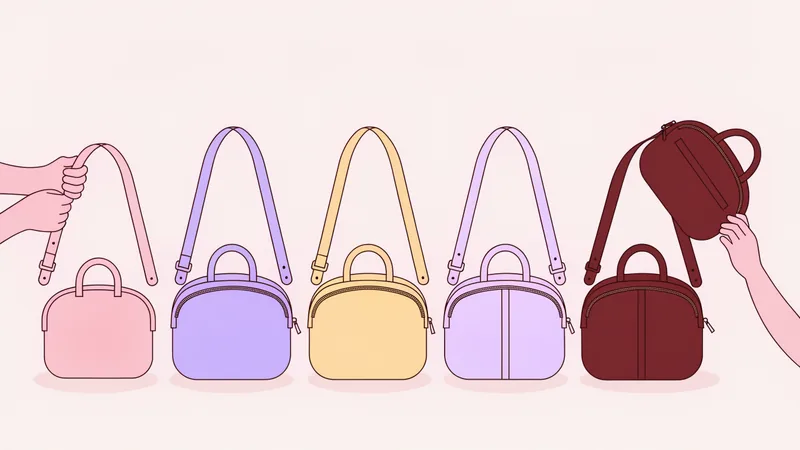
A bag can offer that same separation through a handle or strap instead of waist ties. This comparison concerns how the container is supported, rather than which form came first.
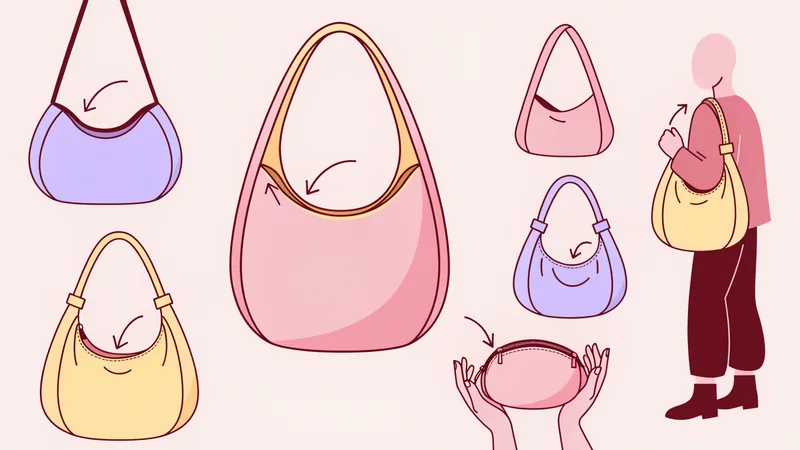
For another way to compare small containers, bag organization layouts considers where storage sits relative to the things around it.
Reticules moved some possessions into view
The Museum at FIT connects narrower early nineteenth-century silhouettes with small handbags carried at the wrist. Its French reticule dated around 1800 was refashioned from an eighteenth-century man's embroidered waistcoat. Reticule and changing silhouette
Court testimony gives a glimpse of what women kept in tie-on pockets. In a Yale University Press essay, Barbara Burman and Ariane Fennetaux describe witnesses naming keys, small tools, and pawnbrokers' tickets among the contents.
A museum can display the French reticule down to the embroidery on its fabric. A court record can preserve a different detail, such as a ticket tucked out of sight in a pocket.
Those accounts help explain what a change in silhouette could mean for the wearer. A wrist bag placed possessions within reach of one hand. A tie-on pocket kept them beneath the skirt and left both hands free.
This is why the question “why do women's clothes have no pockets” needs more than a silhouette explanation. A change in fashionable clothing can explain one pressure on storage. It cannot make every pocket, purse, wearer, and occasion follow an identical sequence.
Designers also brought bags and pockets together
Bonnie Cashin's raincoat, dated around 1965 by FIT, carries a leather pocket designed to resemble a shoulder bag. The museum describes the coat as cotton canvas and leather. The accessory's appearance becomes part of the garment. Cashin raincoat
That makes an interesting reversal of the waistcoat reticule. In one example, garment material becomes a bag. In the other, a bag-like pocket becomes part of a coat.
Avenir Museum also highlights Claire McCardell's approach to usable pockets. Its exhibition discusses the large patch pocket on her 1942 Pop-Over dress and displays a later dress with a generous side-seam pocket. McCardell and pockets
These examples resist the idea that pockets inevitably spoil women's clothing. They show designers making storage part of the design decision.
A pocket can be hidden within a seam, displayed on the surface, or made to resemble another accessory. Those alternatives shift the relationship between garment and container.
The useful comparison is therefore not simply pocket versus handbag. It is where storage belongs, how visible it should be, and which part of the outfit carries it.
Why the complaint still makes sense
The V&A notes that women's clothing can have decorative dummy pockets or pockets too small for useful storage. Its discussion places these frustrations alongside the decline of tie-on pockets. Pocket function
Avenir Museum identifies two explanations commonly offered for fake pockets: preserving a garment's intended silhouette and reducing manufacturing time and cost. Those are design and production priorities, rather than inevitable qualities of women's clothing. Decorative pockets
This brings the historical question back to individual garments. A pocket-shaped flap does not by itself answer whether there is usable storage behind it. Nor does a small compartment answer what it can carry.
The examples above also leave room for choice. A person can value functional clothing pockets and still want a separate bag. Carrying a handbag does not establish that its owner lacked pockets.
Instead of assigning every woman the same reason for carrying one, consider the arrangement. Clothing can carry some possessions, a purse can carry others, and both can have decorative roles. The history of bags places those overlapping uses within a wider carrying story.
FAQ
Did women have pockets before handbags?
Women used separate tie-on pockets, but the history does not divide neatly into pockets followed by bags. The V&A's Lady Clapham example combines both in one wardrobe. That makes coexistence a better description than assuming every handbag replaced a pocket that had disappeared. V&A
What did women keep in tie-on pockets?
The Met lists everyday necessities including keys, thimbles, handkerchiefs, spectacles, and coins. Those examples belong to its explanation of eighteenth-century pockets. They show practical storage needs, rather than a single standard contents list shared by every person who wore a detachable pocket. The Met
Were reticules always large enough to replace a pocket?
The Met describes its early nineteenth-century British reticule as a small bag with very limited carrying space. That example cautions against treating every reticule as equivalent to a substantial storage pocket. Its decorative form and carrying role should be considered together, rather than assuming equal capacity. Reticule record
Why are some pockets fake?
Avenir Museum identifies silhouette and manufacturing cost as common explanations for fake pockets. Those explanations describe design priorities, not a requirement that women's garments lack storage. The same exhibition presents functional pockets, showing that the available choices extend beyond a decorative flap without a usable compartment. Avenir Museum
Sources
- vam.ac.uk/articles/womens-tie-pockets
- vam.ac.uk/articles/make-your-own-pockets
- metmuseum.org/art/collection/search/157045
- metmuseum.org/art/collection/search/156995
- exhibitions.fitnyc.edu/pockets-to-purses
- chhs.colostate.edu/avenir/exhibitions/past-exhibitions/thanks-it-has-pockets
- yalebooks.co.uk/blog/a-pocket-history-of-womens-lives-1660-1900