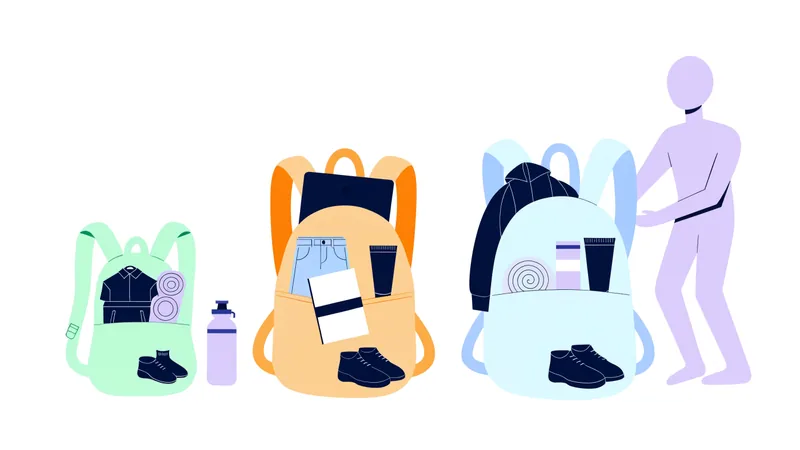
What size suitcase do you need for your trip length?

The short answer to “what size suitcase do I need” is a carry-on (up to 45 L, 18–23 inches) for up to five nights or any trip with laundry. Six to nine nights without laundry: a medium checked case (24–26 inches). Longer: medium or large, and every case must pass your airline’s limits.
Airline rules checked November 7, 2026. Confirm the operating airline’s rules for every flight before traveling.
What size suitcase do I need? Start with this table
Use the table as a starting point for one adult, not a promise that your wardrobe fits.
The capacity bands come from manufacturer luggage guidance. Advertised height is a shopping label, not an airline allowance.
| Trip nights | Starting category | Capacity to investigate | Advertised height category | What changes the choice |
|---|---|---|---|---|
| 1–2 | Carry-on | Around 30–45 L | 18–23 inches | Formal shoes or winter layers can dominate the packing list |
| 3–5 | Carry-on first | Around 30–45 L | 18–23 inches | Check whether outfit reuse is realistic |
| 6–9, with laundry | Carry-on first | Around 30–45 L | 18–23 inches | Pack for the interval between washes |
| 6–9, without laundry | Medium checked | Low end of the 60–120 L checked range | 24–26 inches | Count complete outfits and activity gear |
| 10–14, without laundry | Medium or large checked | Within the 60–120 L checked range | 24–26 or 27–30-plus inches | Lay the load out before choosing large |
| 15 or more | Same as your laundry-cycle row above | Same as that row | Same as that row | Pack for the longest gap between washes, not the trip length |
The 30–45 L short-break range also appears in maker travel-volume guidance. The same luggage guide suggests a carry-on for about 3–6 summer days or 1–3 bulkier winter days, and checked luggage for 1–2 weeks.
For the distinction between volume and exterior measurements, see bag sizes.
Adjust for clothes, laundry and shared packing
Write down your wash days before counting outfits. Two weeks with reliable laundry may need fewer clothes than a week with separate daytime and evening plans.
The underlying questions are laundry access, planned activities, weather and how many people share the case. Decide those before choosing a capacity.
Separate your list into clothing, footwear, toiletries and equipment. Lay out the actual items instead of estimating everything from a folded T-shirt.
Then remove duplicates. Keep the shoes your itinerary needs; reconsider the pair packed for an imaginary dinner invitation.
For shared luggage, create one combined packing layout. Do not simply double a solo traveler’s suitcase size, or assume shared toiletries cancel out extra clothing.
Three common cases:
- Three nights with one dinner: lay out the dinner outfit and shoes before choosing the smaller case.
- Ten nights with laundry halfway: pack around that wash schedule, including a practical delay allowance.
- A family week: compare the combined load against several manageable bags before choosing one large case.
Our packing guides help turn that list into an organized load.
Check airline limits before buying
Trip length tells you how much to pack. Your flight determines the permitted exterior and weight.
For American, a standard carry-on must fit the airport sizer and stay within 22 x 14 x 9 inches. An advertised “22-inch” case still needs its other measurements checked.
For checked luggage, American adds the three outside dimensions and generally allows 62 inches and 50 lb. Its page lists different weight provisions for premium cabins and Australia or New Zealand travel.
Consider a hypothetical checked case measuring 30 x 20 x 12 inches. Its total is 62 inches; adding two inches of expansion would make 64.
Measure your own packed case the same way and check your fare’s conditions.
Meeting the size limit does not make the bag free; check whether your fare includes a checked bag.
Use airline baggage rules as a planning starting point, then follow the operator’s linked policy. Reconfirm before departure, especially for connecting flights.
Measure your suitcase in five steps
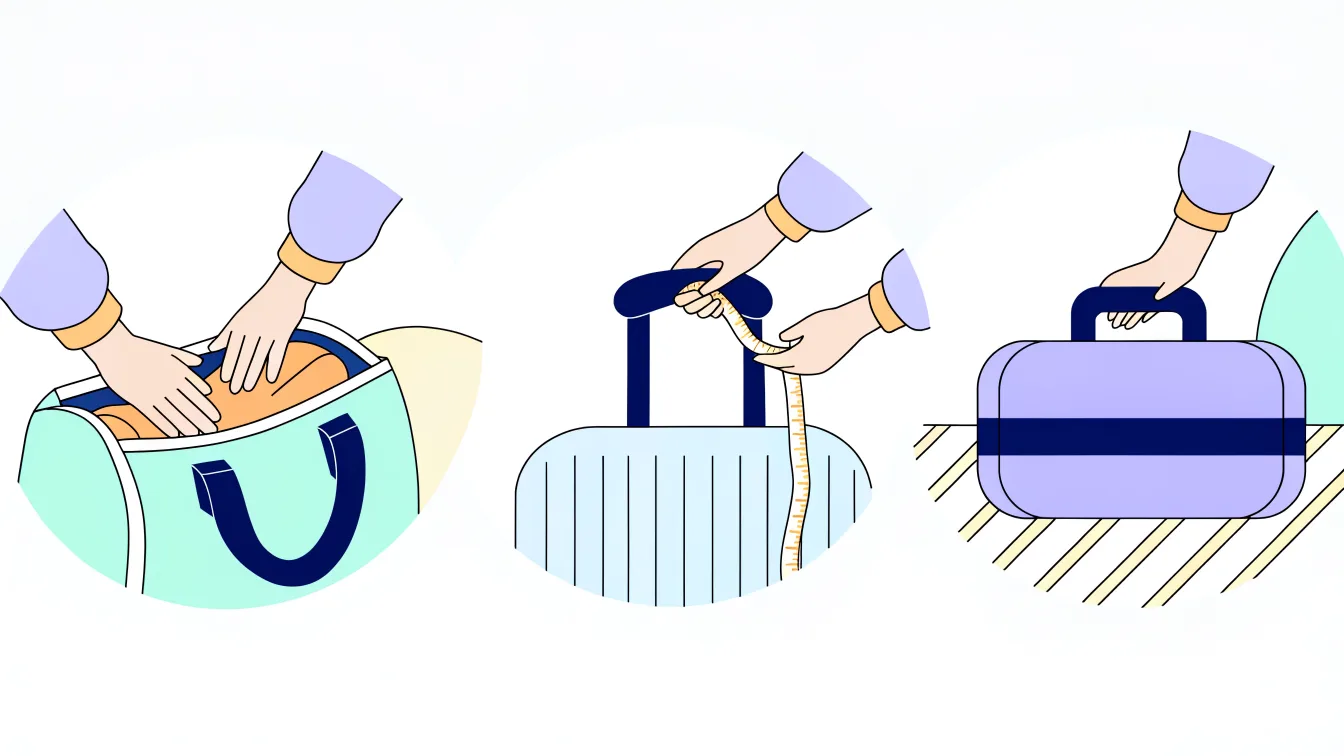
You need a tape measure, a scale and your intended packing list. Note whether each measurement was taken packed, with the handle down and pockets full.
- Pack and close the case. Use the clothing, shoes and accessories you intend to take; do not rely on an empty shell.
- Measure the complete height. Retract the telescoping handle and include the wheels and fixed protrusions.
- Measure the widest width and deepest depth. Include filled exterior pockets and any bulging sections.
- Compare each measurement, or add the three for a linear total. Use whichever method your airline’s page uses, not the size in the product name.
- Weigh the complete load. Repeat after adding purchases or changing what travels in the case.
The exterior approach follows American’s handle-and-wheel cabin rule and outside-dimension checked rule.
Do not multiply the outside measurements and treat the result as usable packing capacity. That calculation describes an enclosing box, including space occupied by the case itself.
If you are shopping online, request complete exterior measurements when only “body dimensions” appear. Keep expansion closed unless its separate measurements satisfy your allowance.
Avoid these sizing mistakes
Buying for the longest possible trip. Start with your recurring packing list. Consider borrowing a larger case for an unusual itinerary before making it your default.
Choosing from capacity alone. Compare the cavity shape with awkward items on your list. A liters figure does not tell you whether your shoes or folded jacket sit conveniently.
Treating the packing target as a requirement. You do not need to fill the case. Leave space deliberately if you expect to bring something home.
Ignoring the loaded bag. Check whether you can manage it through your route’s elevators, steps and transfers. Empty-case handling does not answer that question.
Assuming “large” solves every problem. Decide what would actually occupy the added space. If the answer is vague, revise the packing list first.
For a different way to carry the same load, compare travel backpacks and suitcases.
Make the final choice
Choose the smallest category that holds your realistic packing layout and passes the airline checks. That means carry-on first, medium checked when it does not fit, and large only for a named reason.
Before you buy, confirm the packed measurements and weight against your airline’s page.
FAQ
What size suitcase do I need for a week?
Usually a carry-on, if you will wash clothes once or pack light. One maker’s luggage guide suggests a carry-on for about 3–6 summer days or 1–3 winter days, and checked luggage for 1–2 weeks. Count shoes and special outfits first; if they do not fit the carry-on layout, move to a medium checked case.
Can I use a carry-on for two weeks?
Possibly, if your packing list fits and you can repeat outfits or wash clothes during the trip. Plan around the longest interval without laundry.
Then measure and weigh the finished bag against your operator’s requirements. Two weeks away does not automatically mean two weeks of separate outfits.
Does a 24-inch suitcase count as carry-on luggage?
Do not treat the number in the product name as permission to board with it. American’s standard cabin limit is 22 x 14 x 9 inches including wheels and handles. Compare the complete exterior against your own operator’s policy, checked again before departure, rather than relying on the size label.
Should I buy medium or large checked luggage?
Lay out the items you cannot remove, then compare their fit in the two categories. Check the complete outside measurements and packed weight before choosing. Prefer the medium if it holds your realistic load comfortably; choose the large when specific necessary items justify the extra space and handling.
Sources
- shop.samsonite.com/ultimate-luggage-guide.html
- aa.com/web/i18n/travel-info/baggage/carry-on-baggage.html
- aa.com/web/i18n/travel-info/baggage/checked-baggage-policy.html
- victorinox.com/en/Travel-Gear/Information/The-guide-to-packing-volumes/cms/travel-gear-…
- osprey.com/eu/blog/post/select-right-volume-for-you