Hobo vs satchel vs tote: handbag shapes compared

Hobo vs satchel vs tote: choose a hobo for soft shoulder carry, a satchel for structured organization, and a tote for a roomy, simple opening. The right shape depends on your belongings, preferred access, and how formal you want the bag to look.
Hobo vs satchel vs tote at a glance
| Feature | Hobo | Satchel | Tote |
|---|---|---|---|
| Typical silhouette | Soft, curved, slouchy | Structured, defined | Taller or wider open rectangle |
| Common handle | One shoulder strap | Two top handles; optional long strap | Two shoulder-length handles |
| Organization | One main space | Separated pockets | One large space |
| Opening | Zip or magnetic snap | Zip, flap, or clasp | Open top, magnetic snap, or zip |
| Best carried | On shoulder | By hand, forearm, or crossbody if equipped | On shoulder or by hand |
| Professional appearance | Casual to refined | Polished | Depends on fabric and structure |
| Bulky items | Can be awkward to locate | Limits depend on rigid shape | Convenient to load |
| Most common annoyance | Contents settle at bottom | Rigid edges can feel bulky | Small items disappear inside |
These are tendencies, not standards. A structured hobo can behave like a satchel, and a zip-top tote can be more secure than a loosely fastened satchel.
Choose a hobo if comfort and relaxed style matter
A hobo bag is usually shaped to curve against the body. Its flexible material makes it less boxlike than a structured satchel.
It suits a wallet, phone, keys, sunglasses, and a few soft extras. The look fits casual clothing and many business-casual offices.
The trade-off is internal organization. A flexible main compartment may allow small objects to settle beneath everything else. An organizer insert or a few separate pouches can make a practical difference.
Check that any insert does not destroy the hobo's intended drape. If the bag has a narrow curved opening, it may also be awkward to remove a wide tablet or notebook.
A hobo is not automatically lighter than the alternatives. Thick leather, large hardware, and lining can add weight. Compare empty weight when the maker publishes it.
Test strap drop against the outerwear you use most often. A shoulder strap that works with a T-shirt may feel restrictive over a winter coat.
Pick a hobo when: you want a softer silhouette, mostly carry modest daily essentials, and dislike rigid corners. Avoid one when: you routinely need upright document storage, fast access to many small compartments, or a bag that stands independently on a desk.
Choose a satchel if you want a defined shape
The satchel is a strong choice for an orderly appearance. Its more structured body makes it easier to assign repeatable places to a phone, wallet, small notebook, and keys.
The upright shape may keep items from sliding into a single heap. Top handles suit short walks between a car and an office.
The inconvenience comes with carrying style. A short handle may feel awkward when both hands are occupied. A detachable crossbody strap can solve that, but do not assume it is included.
Verify attachment hardware and adjustable length on the product page. Long straps also change how the satchel rests against the hip.
Before buying a satchel for work, inspect the opening. Some bags are broad at the bottom and comparatively narrow at the top. A laptop can match the external width yet fail to pass through the zipper.
Measure your laptop in its case and compare that with the bag's opening and interior, not its outside width. A padded laptop sleeve is a feature some satchels add; the shape alone does not promise one.
Pick a satchel when: you value a structured shape, defined pockets, and a polished look. Avoid one when: your daily load is bulky and irregular, or you frequently need a large flexible opening.
Choose a tote if carrying space comes first
A tote excels at straightforward loading. Many have a large uninterrupted interior with two handles and a wide mouth.
This makes it easy to carry a sweater, paperback, lunch container, shopping overflow, or a mix of essentials. A tote can be smart enough for work or casual enough for an errand, depending on the material and hardware.
The main question is the closure. An open-top tote gives rapid access but less protection against accidental spills. A zip-top version can be a better choice for transit, though the zipper may narrow the usable opening.
A magnetic closure is convenient but does not seal the compartment. Check for a secure internal pocket for smaller valuables.
Also consider the base. A rectangular, reinforced bottom helps when you need to place the tote upright, while a soft unstructured bottom compresses more easily in storage. Both have advantages.
A stiff, wide bag can become uncomfortable in crowded spaces. A floppy one can be difficult to organize without an insert.
Pick a tote when: you carry mixed bulky items and want quick loading. Avoid one when: you need close-body hands-free wear or dislike searching through a large main compartment.
Compare comfort, access, and security separately
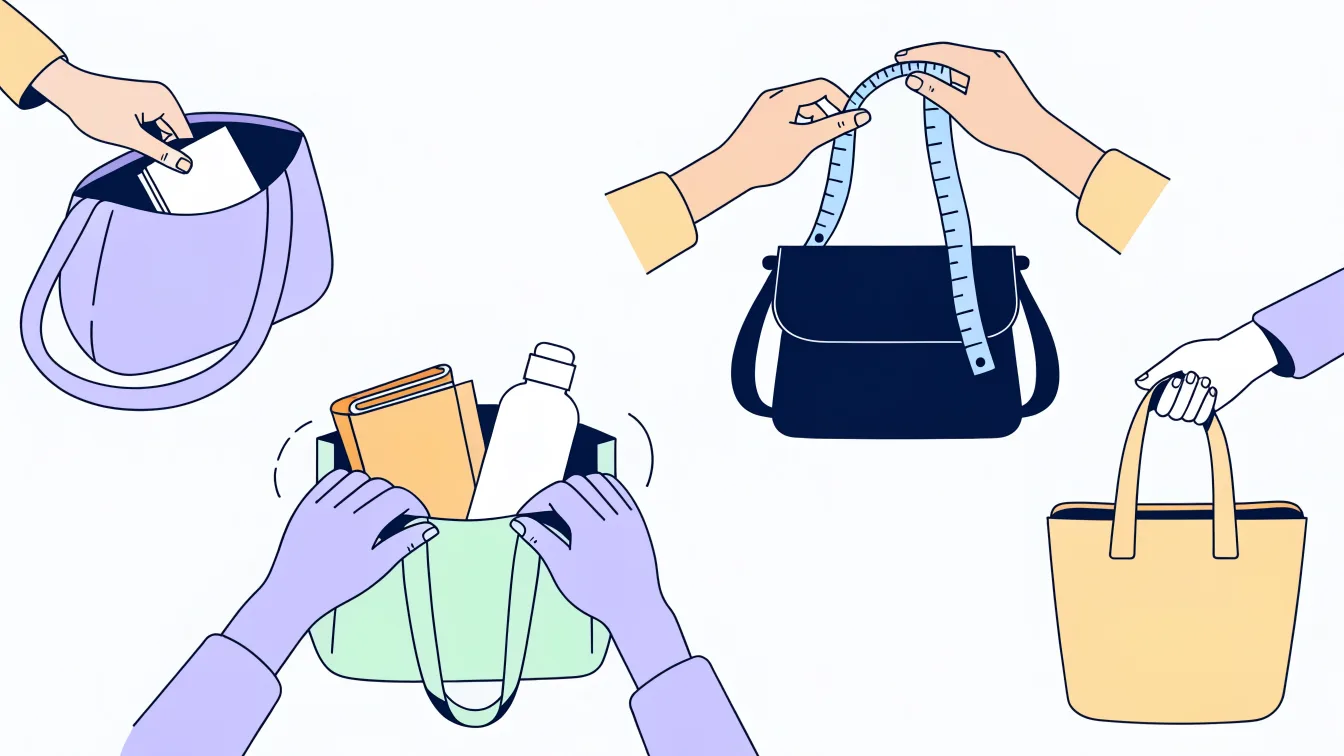
The way you carry a handbag can matter more than its name. A one-shoulder hobo puts load on one side. A tote can do the same, particularly if filled with a laptop and bottles.
A satchel offers hand carry but can become tiring during a long walk. A crossbody strap, where one is included, spreads the load across the body and frees both hands.
Security comes down to the closure and how you carry the bag. A zip-top hobo may contain small items better than an open tote when it tips. A flap satchel can secure its opening, but one unsecured pocket may remain accessible.
Keep valuables in a compartment that closes, whichever shape you pick.
Access is another distinct question. Open totes are easiest to see into when lightly packed. Structured satchels can keep everyday items in known positions.
Hobos may need a simple internal pouch system. Try packing the same daily kit into each shape before choosing. Which arrangement allows you to reach your phone without unloading the entire bag?
When the shape does not matter much
If your daily carry consists of a phone, wallet, keys, and lip balm, any of the three can work. The decision then becomes strap comfort, closure type, weight, and personal style. A compact crossbody may even be a better fit than any full-size handbag.
As with other bag comparisons, the category offers little guidance about rain resistance, leather quality, stitching, or warranty. Those attributes must be checked for each product.
A nylon tote and a leather tote differ more in care than a leather tote and a leather satchel do. For material differences, see the bag materials guide.
Quick decision checklist
- Put your everyday items on a table and measure the widest one.
- Decide if you need a secure zipper or prefer open access.
- Check whether a shoulder strap, long crossbody strap, or top handles suit your commute.
- Compare interior opening dimensions, not only the body width.
- Consider whether you want the bag to stand upright when set down.
- Check available interior pockets and whether an insert would improve usability.
To settle hobo vs satchel vs tote, lean toward a satchel for a structured daily work kit. For everyday flexibility and a soft silhouette, choose a hobo. For books, lunch, clothing, and mixed objects, a tote is usually the easiest shape to pack.
FAQ
Is a hobo bag the same as a shoulder bag?
A hobo is a handbag shape, while a shoulder bag describes how it is carried. Many hobos have shoulder straps, so the categories overlap.
But shoulder bags also include structured rectangles, baguette styles, and other silhouettes. Look at both the shape and the handle arrangement.
Can a satchel be worn crossbody?
Some satchels include an adjustable, detachable long strap; others have only top handles. Check the maker's included accessories and the strap adjustment range. A short or fixed-length strap may not suit your height or preferred carrying position.
Is a tote more useful than a satchel for work?
A tote is often simpler for packing a bulky combination of lunch, papers, and clothing. A satchel may give a tidier shape and dedicated sections. The best work choice depends on your laptop's dimensions, closure needs, and daily carrying distance.
Which handbag shape is more secure?
No shape is automatically secure. A bag with a fully closable top and protected internal pockets can contain belongings better than an open bag.
Even that will not stop every type of theft. Consider closure placement, access, and your typical surroundings.
Do hobo bags lose their shape?
A slouchy shape is often intentional, not a defect. Materials and construction determine whether the bag maintains its intended silhouette. Store it according to its care guidance, avoid overpacking, and consider light stuffing when it is not in use.
Related guides

Hard-shell vs soft-sided luggage: which should you buy?

Spinner vs two-wheel luggage: which rolls better for you?

Travel backpack vs suitcase: which suits your trip?

Laptop backpack vs messenger bag vs briefcase

Rolling backpack vs regular backpack for school