Best soccer bags for kids
We may earn a commission when you buy through links on this page. It never changes what a guide says. How this works.
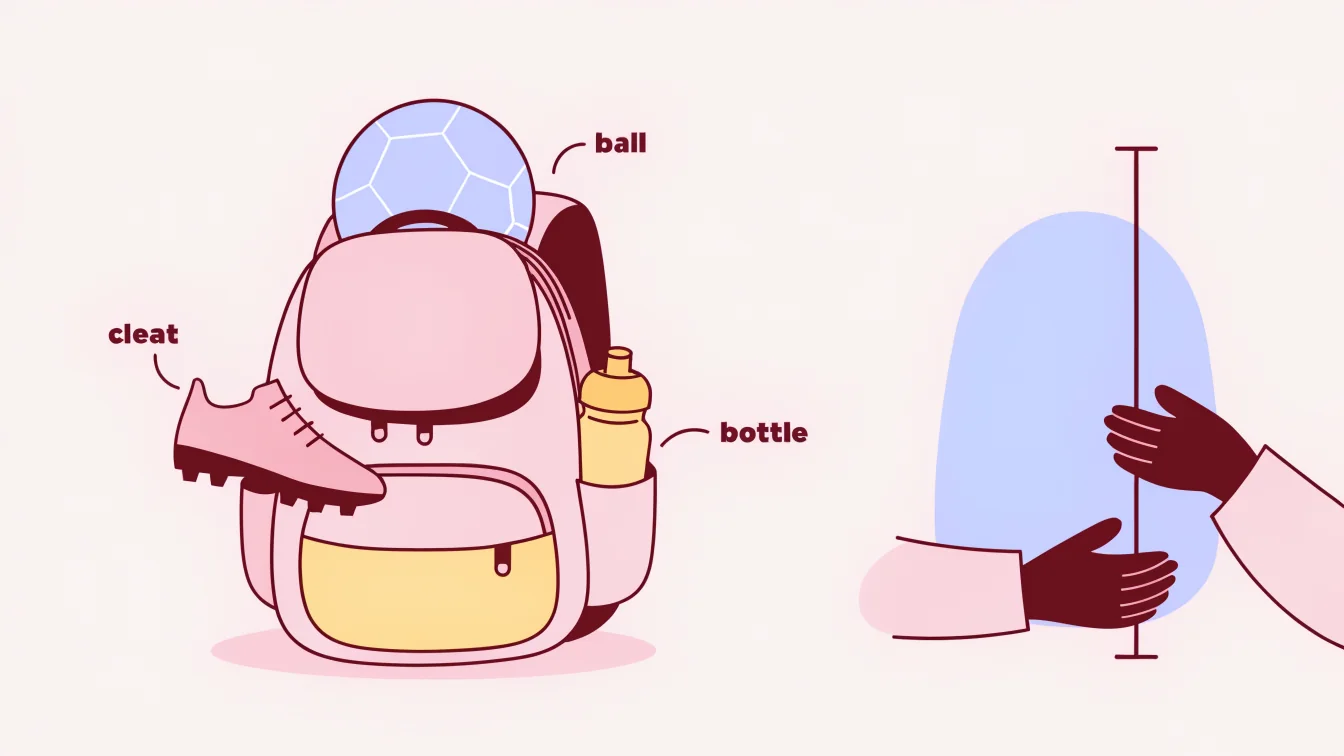
The best soccer bags for kids fit the child's body and separate the gear they actually carry. Check ball storage, cleat placement, and strap adjustment first. Age labels are only starting points; published dimensions cannot guarantee a comfortable fit alone.
Quick picks
| Pick | Best for | Key spec | Price tier |
|---|---|---|---|
| MATEIN Youth Soccer Backpack | A ball compartment plus separate shoe storage | Size 5 soccer-ball compatibility; 27 liters | $ |
| Vizari Solano Soccer Sport Backpack | Younger players who bring their own ball | Size 5 ball pocket; 11 x 8.5 x 16.5 inches | Not shown |
| Nike Academy Team Backpack (30L) | Older players who want a front ball pocket | Front ball pocket; 19 x 13 x 7 inches | $$ |
| Nike Academy Team Kids' Soccer Backpack | Clothes and essentials when a ball holder is unnecessary | 22 liters; wet/dry compartment | $ |
The best soccer bags for kids start from the equipment list, so check whether the team supplies balls at practice. Our gym-bag guide covers other carrying formats when a soccer-specific layout is unnecessary.
How we chose
Picks come from the makers' published specs, ball and shoe storage, and US list prices, plus the American Academy of Pediatrics' backpack guidance. bags.net did not test these bags. Price tiers follow each maker's US list price: $ under $50, $$ $50–$149, $$$ $150–$299, $$$$ $300 and up.
Vizari's US page shows only a sale price for the Solano, with no regular price, so its tier reads "Not shown." This list has four picks rather than five, because other candidates' maker pages did not publish usable specs or prices.
What to look for
Who carries the ball. If each player brings one, look for a holder that names the ball size. MATEIN lists a size 5 compartment, and Nike's 30L has a front ball pocket.
If the coach supplies practice balls, prioritize clothing and footwear instead. A ball pocket the child never uses is just extra bulk.
Check cleat separation precisely. A shoe compartment is different from a shared pocket or an open mesh location. Ask whether cleats occupy their own enclosed space, and whether that space reduces the main compartment's capacity.
Compare the bag with the child. Measure a bag that already fits well and compare it with the candidate. The picks' longest listed dimension runs from 16.5 to 19 inches; the bag-size guide explains why external dimensions and usable storage differ.
Check independent access. If you can try the bag in a store or at home before removing the tags, have the child work the zips, bottle pocket and straps alone. A complicated packing arrangement may require adult help every session.
Keep the daily load realistic. Make room for the required ball, cleats, shin guards, clothing, and drink. Leave optional extras at home.
Capacity describes the bag, not how much a particular child should carry. The AAP's backpack guidance says a pack shouldn't weigh more than 15% of the child's body weight.
Backpacks with dedicated ball storage
MATEIN Youth Soccer Backpack: for a ball and separate cleats
Start here when both ball and shoe storage are essential. MATEIN lists a size 5 soccer-ball compartment, separate shoe compartment, 27-liter capacity, and a fence hook. Its published size is 17.7 x 11.8 x 7.9 inches, with an empty weight of 1.03 pounds.
Price tier: $. A fixed location for the cleats gives the child a straightforward packing sequence after practice.
Watch out for: MATEIN says the shoe compartment fits up to size 11 but does not say which sizing system it uses. It also publishes no minimum age or torso range for the youth label.
Vizari Solano Soccer Sport Backpack: for younger players with a ball
Its longest listed side, 16.5 inches, is the shortest of the four picks. Vizari says the bag is specifically designed for youth sports and has a rubber mesh front ball pocket that fits a size 5 ball. It lists 11 x 8.5 x 16.5-inch dimensions and a ventilated pocket that helps separate cleats from other gear.
Price tier: Not shown. Vizari's page shows a sale price only, so we have no list price to place it in a tier.
Watch out for: Vizari publishes no capacity in liters. Vizari describes the cleat space only as a ventilated pocket and gives no size for it, so try the child's actual pair.
Nike Academy Team Backpack (30L): for older players with a ball
This suits a taller child or teen who brings their own ball. Nike says the bag holds your ball in the front pocket and has padded, adjustable shoulder straps. It lists 19 x 13 x 7-inch dimensions, a 90% polyester/10% nylon body, and a side pocket that houses a rain fly.
Price tier: $$. The extra size over the kids' 22-liter Nike bag is the point, so check its height against the player first.
Watch out for: Nike does not list a separate shoe or cleat compartment, and the product copy gives no age or youth sizing. Nike lists spot-clean care, so muddy cleats are better kept in their own bag.
With any of these bags, pack the ball first and see what room is left.
A simpler choice when the team supplies balls

Nike Academy Team Kids' Soccer Backpack: for clothes and essentials
Consider this when the team supplies the ball, or someone else carries it. Nike lists 22-liter capacity, 18 x 12 x 5-inch dimensions, polyester construction, and a wet/dry compartment. It also has a mesh side bottle pocket and padded, curved shoulder straps.
Price tier: $. At 22 liters it is the lowest published capacity here, which suits a kit without a ball.
Watch out for: Nike does not list a separate ball holder or cleat compartment. Nike does not describe the wet/dry compartment as leakproof. Confirm the bag's height against the child before treating the kids' label as sufficient.
Choosing size as a child grows
Age is a rough filter, not a bag measurement. None of these makers publishes an age-to-size chart, so the table below starts from each bag's listed size and layout.
| Player | Bag to start with | Check |
|---|---|---|
| Younger beginner, team supplies balls | Nike Academy Team Kids' (22 L, 18 in tall) | Closures the child can work alone |
| Younger player with own ball | Vizari Solano (16.5 in longest side, size 5 ball pocket) | The ball and cleats actually fit their pockets |
| School-age player with own ball and cleats | MATEIN (27 L, 17.7 in, size 5 ball compartment) | Loaded weight against the AAP 15% line |
| Taller child or teen | Nike Academy Team 30L (19 in tall) | A separate bag for cleats |
Vizari states only that the pocket fits a size 5 ball; if your child's league uses a smaller ball, check that it stays put.
The AAP's backpack-safety page gives general guidance that applies to any sports pack. Use both shoulder straps, and adjust them so the pack rests in the middle of the child's back. If the child needs to lean forward to carry it, it is too heavy; ask your pediatrician if you have concerns.
Which of the best soccer bags for kids should you buy?
Choose MATEIN when a ball compartment and separate footwear space are your main requirements. Choose the Vizari Solano for a younger player who brings a ball and needs a shorter bag (16.5 inches on its longest side).
Choose the Nike Academy Team (30L) for an older player who carries a ball but can keep cleats in a separate bag. Consider the Nike Academy Team Kids' bag for clothes and essentials when the team supplies the ball.
Before ordering, note where the ball and muddy cleats go and who carries the bag. Our shoe-compartment guide explains more separation options.
Follow the maker's cleaning instructions; the bag-care guide covers the general method. Empty the bag after practice; a vented pocket does not dry cleats on its own.
FAQ
What size soccer bag should I buy for my child's age?
Use age as an initial filter, then compare the bag with the child's current fit and equipment. These makers do not publish universal age bands.
Check loaded height, strap adjustment, and access to closures. Avoid choosing extra capacity solely on the assumption that the child will grow into it.
Does every soccer backpack hold a ball separately?
No. A soccer product name can refer to a general equipment backpack. Look for an explicit ball holder or compartment on the exact model page. Among these picks, the MATEIN, Vizari and Nike 30L list a ball pocket; the Nike kids' 22-liter bag lists none.
Is a wet/dry compartment suitable for muddy cleats?
It may provide a separate location, but the label does not establish cleat compatibility or leak resistance. Check the lining, opening, and maker's cleaning instructions.
Remove loose dirt before packing when practical. If cleats must share the main compartment, put them in a plastic or mesh shoe bag first.
Should I choose padded straps or drawstrings?
Compare both with the child's actual load and usual journey. Padding is a construction feature, not proof of comfort.
A drawstring sack suits a light kit only. For a ball, cleats and a bottle, use a pack with two padded straps; the AAP advises using both shoulder straps.
Sources
- nike.com/t/academy-team-kids-soccer-backpack-22l-CncxFQ
- matein.com/products/matein-basketball-sports-backpack-with-laptop-compartment
- nike.com/t/academy-team-backpack-30l-qDB2Kk
- vizari.com/products/solano-soccer-sport-backpack-pink
- healthychildren.org/English/safety-prevention/at-play/Pages/Backpack-Safety.aspx